

Nvidia has once again proven why it is at the forefront of the whole AI revolution. The chipmaker reported a staggering revenue of $46.7 billion (£34.6 billion) in the second quarter of 2025, representing a 56% increase compared to the same quarter last year.
While the results highlight Nvidia’s unmatched role in powering artificial intelligence, investors reacted cautiously. Shares dipped slightly in after-hours trading, a sign that even record-breaking numbers can’t fully shield the company from geopolitical headwinds.
AI Demand Driving Unstoppable Growth
At the heart of Nvidia’s success is the explosive demand for AI chips. Its advanced processors are essential to powering platforms built by some of the world’s biggest tech players — from Meta to OpenAI.
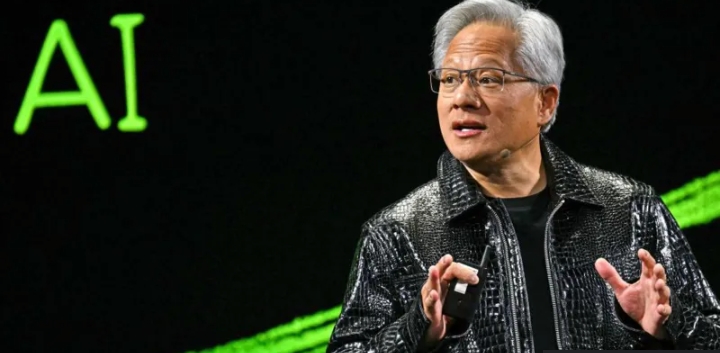
Chief executive Jensen Huang, speaking after the earnings release, emphasised just how much momentum the AI industry has gathered. According to him, spending by four major tech firms has doubled to $600bn per year..
The AI race is now on,” Huang declared. “Over time, artificial intelligence could even accelerate global GDP growth — and Nvidia’s is a crucial part of that transformation.
”The company’s data centre revenue surged 56% to $41.1bn, underlining just how much cloud providers and tech giants are leaning on Nvidia’s technology to train and deploy large AI models.
Topics
Investors React to Mixed Signals
Despite these impressive numbers, Wall Street had expected slightly more from Nvidia’s data centre business, leading to a mild “wobble” in the stock price.
Eileen Burbidge, an investor at Passion Capital, described the growth as “unbelievable” but admitted there might be a touch of overexcitement in the market. “There’s clearly been so much capital that’s gone in that it’s fair to say there could be a bit of a bubble forming,” she noted.
Still, analysts agree that Nvidia’s long-term prospects remain solid. Colleen McHugh, chief investment officer at Wealthify, called Nvidia “at the heart of the AI boom” and highlighted that no real competitors have managed to challenge its dominance in AI chips.
Geopolitical Pressures Could Slow Momentum
For all its financial success, Nvidia’s continues to face challenges that money alone cannot solve. The company remains caught in the middle of US-China trade tensions, which directly affect its ability to sell its most advanced chips abroad.
Earlier this year, Nvidia successfully lobbied the US government to allow sales of its H20 chips in China — processors tailored specifically for that market. However, in July, the government announced it was reviewing licenses for these sales.
So far, Nvidia has not shipped any H20 units, even though some Chinese customers recently received approval. Adding another layer of uncertainty, the US government is also set to claim 15% of revenue from licensed H20 sales.
Nvidia is now pushing to gain approval for its next-generation Blackwell chips in China, the company’s single largest market. Meanwhile, Beijing is doubling down on developing its own domestic chipmakers, raising concerns that local competitors could gradually chip away at Nvidia’s dominance.
A Balancing Act Between Growth and Risk
The big question for Nvidia is whether the AI boom can continue to outpace the risks of geopolitical turbulence. On one hand, the company is on track to deliver $54bn in revenue next quarter, well above Wall Street’s expectations. On the other, the political landscape — particularly in the US and China — could restrict its biggest growth engine.
Industry analyst Jacob Bourne put it bluntly: “US export restrictions are fuelling domestic chipmaking in China. The real test for Nvidia will be whether it can expand into areas like robotics while staying ahead in AI chips.”
The Bigger Picture
In July, Nvidia became the world’s first $4 trillion company, a milestone that reflects not just investor optimism but also the central role the company plays in the future of technology.
Still, even giants can falter. Nvidia’s now finds itself balancing the optimism of breaking records and the reality of political risks. For investors, this means Nvidia remains a high-return but high-risk stock — one that could keep growing if AI adoption continues at its current pace, but could also be hurt by trade sanctions and global rivalry..
As Huang summed it up: “Our role is to build the infrastructure of AI. The world is racing ahead — and so are we.”
Read more: Best Life Insurance for Over 50 in the UK [2025 Guide]